











(Surabaya, 22 Oct 2025) Amidst global economic turmoil and digital disruption (algorithmic authority), sustainable resilience requires synchronization between formal law and community ethics, especially to ensure social justice and harmony.
Therefore, in the Parallel Session held during the 2025 Sunan Ampel International Conference on Political Science and Social Science (SAICoPSS), there was an interesting discussion on social conflict and the role of domestic policy. This parallel session was held on the second day of SAICoPSS, specifically on Wednesday, October 22, 2025. The session was divided into five rooms with different themes. This discussion was a sub-theme of room 6. However, the parallel session, which was supposed to start at 1:00 p.m., was delayed for a few minutes while waiting for the reviewers to arrive, namely Mr. Abid Rohman. Room 6 had four presenters, including: Firqah Annajiyah Mansyuroh and Muhammad Torieq Abdillah from UIN Antasari Banjarmasin, Yuyun Yuningsih and Susi Dian Rahayu from Universitas Islam 45 Bekasi, Khudrotun Nafisah and her friend from Brawijaya University and Malang State University, and finally Nashrulloh Ahsan and his friend from Tribakti Lirboyo Islamic University in Kediri. The other two presenters are not present at that time.
The first presenter delivered an article titled “When Law Speaks, Economy Acts: A Normative Assessment of Trump’s Import Tariffs and Indonesia’s Halal Industry Strategy for Economic Resilience.” Firqah Annajiyah Mansyuroh and Muhammad Torieq Abdillah aimed to evaluate Trump’s import tariffs from a normative legal perspective within the framework of international trade law, to analyze their impact on Indonesia’s economic resilience efforts, and to explore the role of the halal industry as an adaptive strategy. The reviewers approved the content and presentation, but suggested that the research article be supplemented with data on the impact of Trump’s policies on the halal industry.
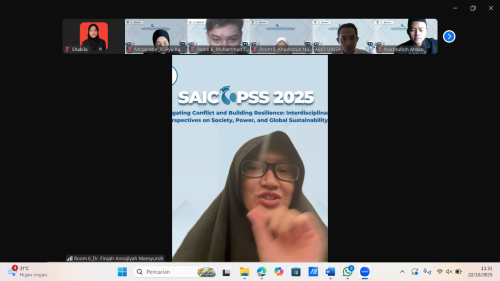
The second presenter actually had two authors, but at that time only Susi Dian Rahayu presented the article entitled “How Regional Policies Protect Female Workers: Case Study of Bekasi Regency Regional Regulation Number 5 of 2020.” Through this article, the authors aimed to analyze the implementation of regional regulations using Van Meter and Van Horn’s policy implementation theory, which covers six variables: policy standards and objectives, resources, characteristics of the implementing organization, communication, implementer disposition, and socio-political conditions. The reviewer initially had difficulty understanding the research objectives because the content and abstract were not quite in sync. He also suggested that the article should only focus on the implementation of local government policies.

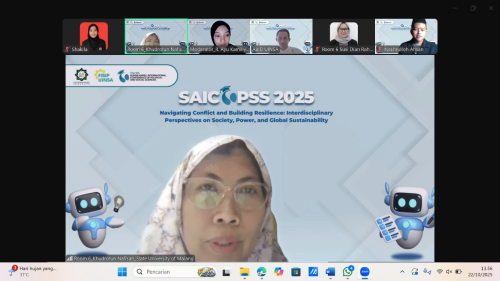
The third article was presented by Khudrotun Nafisah, entitled “Algorithmic Piety and Spiritual Resilience: Hybrid Religious Digipreneurship in Yuk Ngaji Malang.” She examined how Yuk Ngaji Malang, an Islamic hijrah movement oriented towards young people, expanded its offline religious activities into Instagram feeds while facing state restrictions, algorithmic amplification, and digital consumerism. Using netnographic design and Repenning and Oechslen’s platform-mediated practice framework, 191 posts (79 images/carousels and 112 videos) from January to August 2025 were analyzed. The reviewer provided brief suggestions to explain the Yuk Ngaji Malang platform in more detail to give readers a deeper understanding.
The last presenter was Nashrulloh from Tribakti Lirboyo Islamic University, with the article title “Ella English Course Pare Kediri’s Strategy In Shaping Religious Moderation Values.” The author intended to examine Ella English Course Pare Kediri’s strategy in shaping religious moderation values using Gus Dur’s principles. However, the reviewer found that there was no explanation of why Ella English Course applied these principles and how they were implemented. Therefore, this became a note of advice for the author to revise.

Despite Indonesia facing global disruption (such as US tariff protectionism that weakens the WTO) and digital adaptation challenges (religious authorities transforming into algorithmic content), national resilience is built through two main pillars. First, a value-based strategic response, namely strengthening the halal industry as an ethical counter-strategy. Second, strengthening policy implementation at the local level. The success in creating social justice (protecting female workers) and harmony between identities (moderation in non-formal institutions) still requires optimization of resources and socialization, indicating that sustainable resilience requires integration between formal law and community ethics. (RAKZ)
Untuk informasi lebih lanjut mengenai kegiatan dan program FISIP UINSA, silakan kunjungi dan ikuti media sosial kami di Instagram