










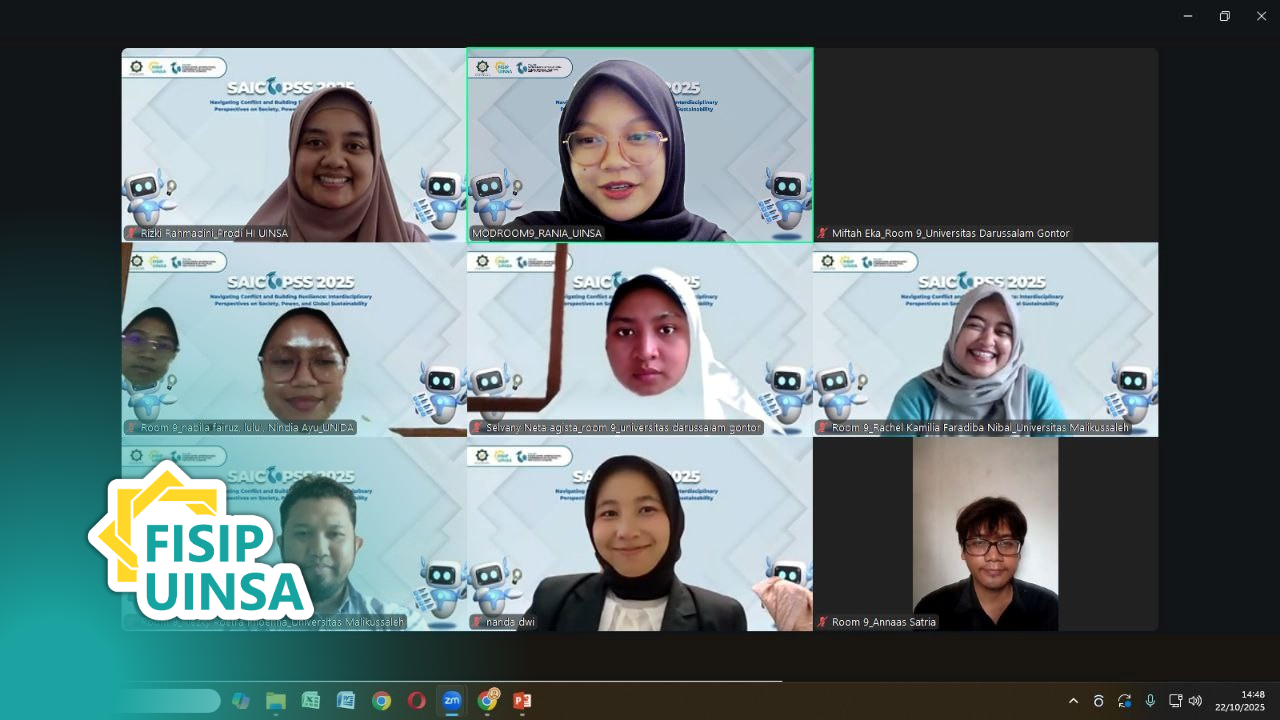
SURABAYA, [22 October 2025] – The prestigious international conference, Sunan Ampel International Conference of Political and Social Sciences 2025 (SAICOPSS 2025), was once again held successfully. With the main theme “Navigating Conflict and Building Resilience: Interdisciplinary Perspectives on Society, Power, and Global Sustainability,” this conference became a forum for academics to exchange ideas on the most pressing global issues.
One of the most dynamic panel sessions was the one focusing on the sub theme “War and Conflict Prevention in a Multipolar World.” This crucial session was guided by Rania Nisrina Sholichah, who acted as moderator for five presenters who presented their research findings. The panel discussion highlighted a broad spectrum, ranging from the failure to enforce humanitarian law in war zones to the rise of civil society advocacy movements.
Humanitarian Law Gaps in Syria and Kashmir
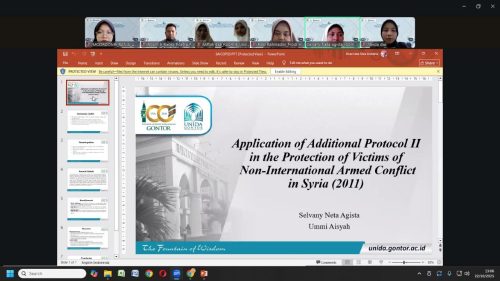
The session opened with two in depth analyses of the challenges of enforcing International Humanitarian Law (IHL). First, Selvany Nela Agista from Gontor University presented her research entitled “Application of Additional Protocol II in the Protection of Victims of Non-International Armed Conflict in Syria (2011)”. Agista qualified the Syrian conflict as a Non-International Armed Conflict (NIAC) and emphasized that even though Syria has not ratified Additional Protocol II, its principles remain binding as customary international law. Her research highlighted various serious violations, such as attacks on medical facilities and the use of chemical weapons. She concluded that the Syrian conflict is a test of credibility for the IHL, which will remain symbolic without political commitment and the strengthening of institutions such as the ICC and the UN Security Council.
Continuing the theme of the failure to implement the IHL, the second presenter analyzed the protracted conflict in Jammu and Kashmir. This research highlights how Indian military practices such as large-scale operations and the use of lethal weapons in densely populated areas create “an imbalance between military objectives and their impact on the civilian population.” These actions are confirmed to often “exceed the limits of proportionality” set out in Protocol I. The presentation also critically pointed to obstacles to accountability, namely the fact that India is not a party to the Rome Statute (ICC) and the existence of veto protection in the UN Security Council that hinders international oversight.
Civil Advocacy Against Militarism and Extractivism
The discussion then turned to civil society response strategies to conflict. The third presenter presented a case study of the “All-Okinawa Council’s Transnational Advocacy Network Strategy in Response Towards the United States’ Military Base Construction in Okinawa.” Driven by environmental and security concerns, the council effectively implemented four transnational advocacy strategies (Keck & Sikkink, 1998): Information Politics which is sending delegations to the U.S. and Europe, Symbolic Politics which is the ‘All-Okinawa’ slogan and the ‘Save the Dugong’ alliance with Greenpeace, Leveraging Politics as an advocacy at the UN Human Rights Council, and Accountability Politics which is collaborating with local governors such as Denny Tamaki.
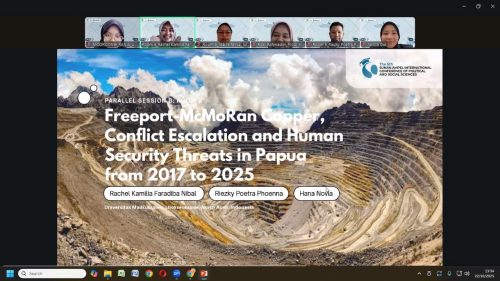
Next, the fourth presenters is Rachel Kamilia Faradiba Nibal, Riezky Poetra Phoenina, and Hana Novia. They shifted the focus to natural resource conflicts in Papua with their presentation “Freeport-McMoRan Copper: From Conflict Escalation and Human Security Threats in Papua from 2017 to 2025.” This research reveals a “Core Paradox”: Indonesia’s acquisition of a 51% majority stake in PT Freeport did not improve the welfare of Papua. On the contrary, it has resulted in new human security threats and perpetuated “structural violence” and “forced dependency.” Various security threats ranging from economic or mass layoffs, environmental damage, to personal or human rights violations are dissected, revealing a huge contradiction between the company’s CSR claims and the reality of the community’s suffering on the ground.
The Rise of Advocacy Movements in the United States
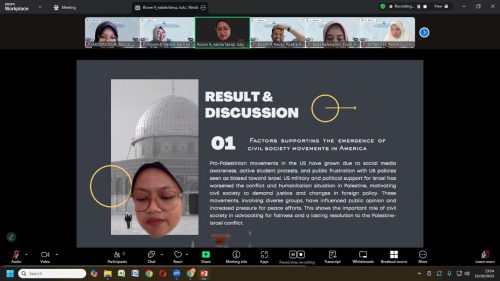
In closing, the fifth presenter analyzed the factors that drove the emergence of civil society movements in the United States related to the Israeli-Palestinian conflict. This research highlights how public dissatisfaction with US policy, coupled with the power of social media and student protests, has fueled demands for justice. Taking lessons from the Black Lives Matter movement in 2020, the student led pro Palestinian movement used tactics such as university occupations and demands for divestment to challenge the mainstream media narrative.
This Parallel Session not only presented diverse case studies, but also successfully wove together a strong common thread, all of which converged on the sub theme of “War and conflict prevention in a multipolar world.” Collectively, the five presentations described the increasingly complex and challenging landscape of modern conflict.
The discussion highlighted two key realities in today’s multipolar world. The Failure of Traditional Frameworks, the case studies of Syria and Kashmir are clear reflections of the failure of the post-World War II security framework. Both presentations show how the political intervention of major countries or multipolarity and jurisdictional barriers such as the use of vetoes in the UN Security Council or the non ratification of the Rome Statute effectively paralyze international humanitarian law. This confirms that top down conflict prevention by states is now facing a credibility test. The Rise of Non State Actors, on the other hand, the last three presentations show where new arenas of conflict are emerging.
The case of Papua expands the definition of conflict beyond inter state warfare. This presentation identifies structural violence driven by the interests of multinational corporations and states, proving that the greatest threat to human security no longer comes solely from weapons, but from paradoxical extractive policies.
In response to this impasse and new forms of conflict, the case studies of Okinawa and the pro-Palestinian movement in the U.S. offer a vision of from the ground conflict prevention. Both are powerful examples of how civil society and transnational advocacy networks are now taking center stage. When state institutions fail to act, it is these citizen and student led movements that rise up to challenge militarization and established foreign policy.
Overall, the session concluded with a clear understanding, that war prevention in the multipolar era can no longer rely solely on stagnant global institutions. It requires a deeper understanding of the structural conflicts caused by corporate actors and, most importantly, places the power of civil society advocacy as a key pillar in demanding accountability and building sustainable peace. (RNS)
Untuk informasi lebih lanjut mengenai kegiatan dan program FISIP UINSA, silakan kunjungi dan ikuti media sosial kami di Instagram.