











(Surabaya, 21 Oct 2025) – The UIN Sunan Ampel Surabaya International Conference on Political and Social Sciences (SAICoPSS) highlighted the arenas of humanitarian struggle that are often overlooked by the public.
The first presentation by Sukendar from Walisongo State Islamic University in Semarang opened the session with a touching account of the reality on the front lines of gender based violence (GBV) services. His narrative study revealed that victim advocates at the Central Java Regional Technical Implementation Unit for Women and Child Protection not only bear a heavy emotional burden, but also face secondary trauma and real threats.
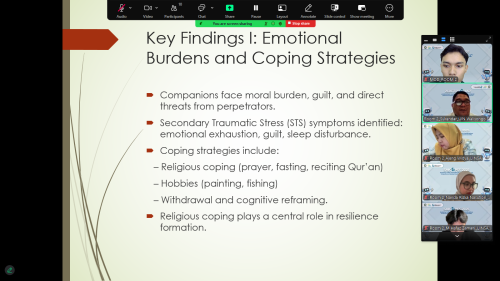
“They struggle with emotional burdens and secondary trauma,” said Sukendar. He recounted how advocates experience deep guilt when victims choose to return to their abusers, or even face direct threats from perpetrators that disrupt their personal lives.
Ironically, while these advocates serve as pillars of strength for victims, they themselves work in fragile institutional environments. Institutional support is weak, Sukendar emphasized. They rely heavily on the support of colleagues and family, as well as religious coping mechanisms to survive.
The study found that their main motivation for persevering is a moral calling and replacement resilience the ability to empathize with the resilience of the victims they accompany. However, they voice an urgent need for institutional change, including professional recognition, legal protection, and better facilities.
Contested Space: When the State and Citizens Compete for the Meaning of Railway Boundaries
Shifting from personal space to public space, the second presentation by Wahyu Kuncoro and Galang Geraldy from Wijaya Kusuma University in Surabaya highlighted the latent conflict in the Dupak Magersari railway boundary area in Surabaya.
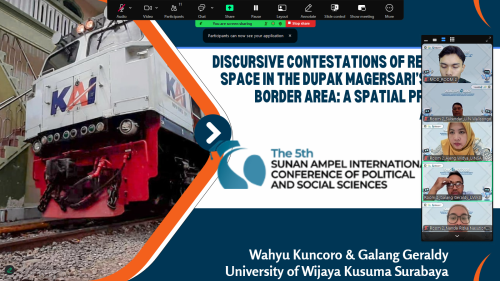
This research uses Henri Lefebvre’s Spatial Production theory framework to deconstruct how this space has become an arena of contestation.
“On the one hand, the state and PT KAI represent this space as a sterile zone that must comply with the rule of law, order, and modernization,” explained Wahyu Kuncoro. According to him, the state uses regulations such as Law No. 23/2007 and the Regional Spatial Planning Regulation as the dominant discourse to legitimize evictions.
But on the other hand, residents produce lived space. For them, this is not a sterile zone, but a source of life, a place of social solidarity, and a symbol of identity built through daily practices.
This research shows that residents daily activities such as trading, building multifunctional houses, or holding rituals become a form of resistance against state hegemony.
This space along the railroad tracks is not simply illegal. It is a socio political product born from longterm negotiations between state hegemony and resident agency.
Both studies deliver a powerful message to policymakers. Whether in designing support systems for social workers or in planning urban spatial arrangements, it reminds us that lived human experience, social solidarity, and moral imperatives often prove to be more resilient forces than mere formal rules.
Different Realities in the Same Train Carriage: SAICoPSS Study Reveals Gender ‘Burden of Fear’ on Jabodetabek Commuter Trains
The crowded carriages of the Jabodetabek Commuter Line may look the same to all passengers, but a new study reveals a very different reality for male and female commuters. Arya Mayadi, a researcher from the Center for Environmental, Maritime, and Sustainable Culture Archaeology Research, explained that women bear an additional burden of fear that is not felt by male commuters, who tend to prioritize efficiency.
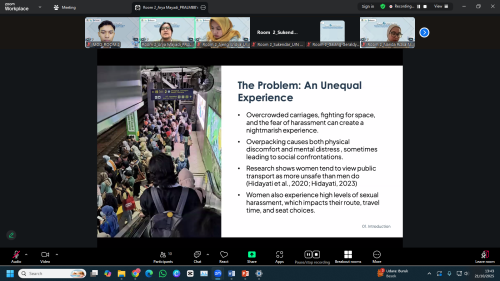
In his presentation, Mayadi explained that this qualitative study focused on the experiences of commuters on the busy Jakarta-Bogor and Jakarta-Cikarang routes.
The study found that KRL commutes are synonymous with crowding and feeling cramped. While male commuters are generally not too bothered by the crowds, female commuters experience heightened unease in mixed carriages during rush hour.
For many women, this unavoidable physical contact is the main reason for consistently choosing women-only carriages (WOC).
Honestly, no matter how safe it is, being in a mixed carriage still makes it uncomfortable, especially when standing close to men. Female commuters feel in mixed carriages, they had to be constantly aware against theft and potential harassment, which made the journey exhausting. In contrast, male commuters feels that they did not feel disturbed in mixed carriages, and felt more relaxed and their main focus was getting to his destination. However, one male respondent, admitted that he sometimes felt awkward when too close to female passengers and was aware that some men might deliberately take advantage of the crowded conditions.
The study found that all participants, both male and female, agreed that the existence of Women-Only Carriages was very important. WOCs are considered effective in providing a sense of security from harassment and offering psychological comfort by avoiding anxiety caused by direct physical contact with male passengers. “If I have to be crowded with someone, at least it’s another woman,” said one of the female commuters, highlighting WOCs as a protective space.
However, Mayadi also explained that WOCs are not without problems. These “safe zones” have their own challenges.
Study participants noted that WOCs can sometimes feel noisier, more assertive, or rougher than mixed carriages, especially during rush hour.
“This can lead to pushing, fighting over seats, or refusing to give up priority seats,” explained Mayadi.
Arya Mayadi concluded that the commuter experience on the KRL is highly shaped by gender. To address this, women employ self-regulation strategies,particularly by choosing WOC. “This study underscores the need for transportation policies that acknowledge gender-based experiences,” he concluded. The goal is to create “truly inclusive and safe public spaces” for everyone.
SAICoPSS Research: Strong Synergy Between City Government and Residents is Key to Overcoming Flooding in Surabaya, But These 5 Challenges Remain
The city of Surabaya has shown significant progress in addressing flooding thanks to a strong Collaborative Governance model. However, a number of technical, social, and political challenges still hinder efforts to achieve a comprehensive solution.
These are the main findings presented by Holilah, M. Zainur Rizky Muyassar, and M. Hafaz Zamani from UIN Sunan Ampel at The Sunan Ampel International Conference of Political and Social Sciences (SAICoPSS).
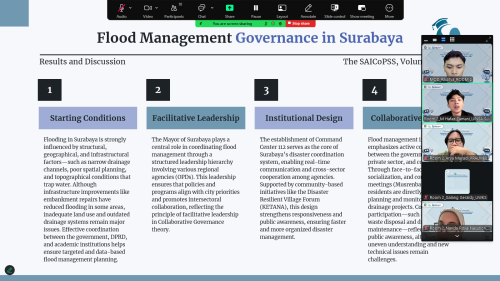
The presentation highlighted that although flooding still occurs repeatedly in Surabaya, the city has implemented an effective collaborative framework involving synergy between the government, community, and private sector.
The research, which used a qualitative approach by interviewing seven key informants including DSDABM, BPBD, DPRD, and affected residents identified several pillars of the Surabaya model’s success.
The Facilitative Leadership of the Mayor of Surabaya played a central role in coordinating various Regional Apparatus Organizations (OPD). Institutional Design was also key, with Command Center 112 serving as a disaster coordination center, enabling rapid and organized cross sector communication. This was supported by community based initiatives such as the Disaster Resilient Village Forum (KETANA).
In addition, an active Collaborative Process through face to face dialogue, socialization, and Musrenbang the Development Planning Consultative Meetings has directly involved residents in the planning and monitoring of drainage projects.
Although this collaborative model has improved flood response, Mr. Hafaz identifies five major challenges that remain in this study:
- Lack of Public Awareness: Many residents still do not understand disaster management procedures, resulting in low participation and confusion when disasters occur.
- Physical Conditions and Infrastructure: There are limitations in drainage capacity and land availability for flood control infrastructure. Development often faces public resistance due to impacts such as noise or dust.
- Extreme Weather and Climate Change: Unpredictable and intense rainfall patterns make planning difficult.
- Land Use Issues: Conflicts over land status and ownership often delay infrastructure projects.
- Socio Political Factors: Resistance from influential individuals or groups, sometimes driven by personal or political interests, can hinder infrastructure development.
- The study concludes that synergy in Surabaya is effective, but recommends the need for improved public education, strengthened coordination, and expansion of the disaster management information system to address remaining challenges.
SAICoPSS Research: Urban Stunting Is a Social Justice Issue, Not Just a Nutritional Problem
Stunting in children in urban areas is not merely a medical problem or a matter of malnutrition, but rather a structural manifestation of social injustice. A study presented by Endah Wahyuningsih at The Sunan Ampel International Conference of Political and Social Sciences (SAICoPSS) challenges conventional views and urges a shift in the focus of intervention.

This research confirms that even though cities offer better health facilities and food markets, the paradox of urban poverty creates service segregation and structural discrimination that limits marginalized groups access to nutritious food and health care. “Children from poor families remain the group most at risk of stunting, even when they live close to health facilities,” explained Ms. Endah. This shows that geographical closeness does not guarantee equal access.
The study highlights that current stunting interventions remain too focused on medical aspects, such as nutritional supplements, without addressing deeper social roots. As a result, poor families in urban areas are forced to make critical nutritional compromises, such as reducing meal portions, substituting nutritious foods with cheaper alternatives, or even selling assets to survive. This phenomenon is getting worse by the stigma of poverty and gender inequality in food allocation at the household level. “This phenomenon reveals that urban stunting reflects social injustice that demands cross-sectoral solutions,” the researchers assert.
Despite facing structural difficulties, urban poor families are not passive. They rely on social capital, such as community support, religious values, and social solidarity, as coping strategies. This study concludes that stunting cannot be resolved through medical intervention alone. It demands comprehensive, inclusive, and socially just solutions.
The contribution of this research is twofold: theoretically, it combines biopolitical, postcolonial, and social stratification perspectives, practically, it provides a basis for policies that promote social justice and community resilience.
“Addressing urban stunting is not just about improving nutrition, but about restoring social justice,” concluded Ms. Endah. “A truly effective response must connect policy, community, and culture bridging medical interventions with sustainable social development.”
Airlangga University Researchers Reveals YouTube Has Become a New Arena for Lecturers to Fight for Welfare
Amidst the ever evolving digital era, a critical study by academics at Airlangga University (Unair) highlights the unexpected role of YouTube as a digital public space for lecturers in Indonesia. This video sharing platform has transformed into an arena for policy deliberation, where educators voice their concerns about welfare, workload, and wage inequality.
These findings were presented at The Sunan Ampel International Conference of Political and Social Sciences (SAICoPSS) 2025. The study, titled “Configuring Lecturer Well-Being Policy Deliberation on YouTube: A Critical Study of Virtual Netnography through a Systematic Literature Review,” was conducted by a team of researchers consisting of Choirul Anam, Bintoro Wardiyanto, and Suko Widodo.
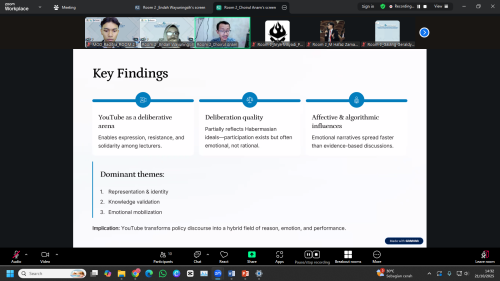
The research team identified that YouTube is no longer just an entertainment platform, but has become a digital public space where social and political discourse is negotiated.
“Lecturers use this platform to voice various crucial issues related to their welfare, such as heavy workloads, wage inequality, and bureaucratic complexities,” Mr. Choirul Anam in their presentation.
This study was motivated by the lack of previous research specifically examining the use of YouTube for academic welfare discourse, so this study aims to fill that gap. This study produced several key findings that change the way we view policy deliberation in the digital age, YouTube as a Deliberative Arena that this platform effectively serves as a forum for lecturers to express themselves, show resistance, and build solidarity on policy issues that affect them. Hybrid Quality of Deliberation, although there are elements of rational deliberation as idealized by philosopher Jürgen Habermas, the discussions that take place are often dominated by emotional narratives rather than rational, data based arguments. Affective and Algorithmic Influence, the study found that emotional narratives spread faster and more widely than evidence based discussions. YouTube’s algorithms tend to reinforce content that elicits strong emotional responses from viewers.
“The implication is that YouTube transforms policy discourse into a hybrid field that combines reason, emotion, and performance,” the researchers concluded. This study makes an important contribution to the development of Habermas’ public sphere theory by introducing new variables, namely affective and algorithmic mediation in public discourse. In addition, this study concretely demonstrates YouTube’s vital role as a platform for policy communication and academic activism.
Political Party Transformation as the Key to Democratic Resilience
A keynote presentation at SAICoPSS 2025 highlighted the global democratic crisis and emphasized that political parties must undergo fundamental transformation. They can no longer be mere electoral machines, but must evolve into key pillars in maintaining democratic resilience.
Global democracy is currently being eroded by three major challenges such as Social Conflict Tensions between groups due to inequality and differences in identity. Digital Disinformation, the massive spread of fake news that undermines public trust. Political Polarization, extreme political divisions that close the space for dialogue and compromise.
The Core Problem is political parties often fail to perform their strategic function in overcoming this crisis. To be part of the solution, political parties must perform three crucial functions. Conflict Mediator, actively channel public aspirations and manage differences to prevent violence. Political education agents, responsible for improving citizens literacy and critical thinking in the era of disinformation. True Representative Institutions, ensuring that the voices and interests of marginalized groups are truly represented in policy.
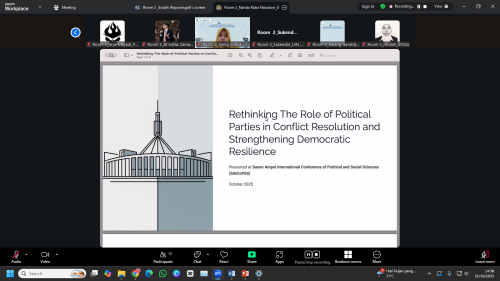
This transformation requires concrete action through four reform agendas, Internal democratization that making party structures more open, accountable, and participatory. Capacity building for framework that training party members in conflict resolution, ethics, and policy analysis. Cross party collaboration, working together to address larger national issues such as crises and institutional reform. Structural Inclusivity: Providing leadership opportunities for women, youth, and minority groups.
The main message of this presentation is urgency. Without fundamental change, political parties will lose their legitimacy and relevance, which will ultimately jeopardize the stability of the democratic system as a whole. (RPS)
Untuk informasi lebih lanjut mengenai kegiatan dan program FISIP UINSA, silakan kunjungi dan ikuti media sosial kami di Instagram.