










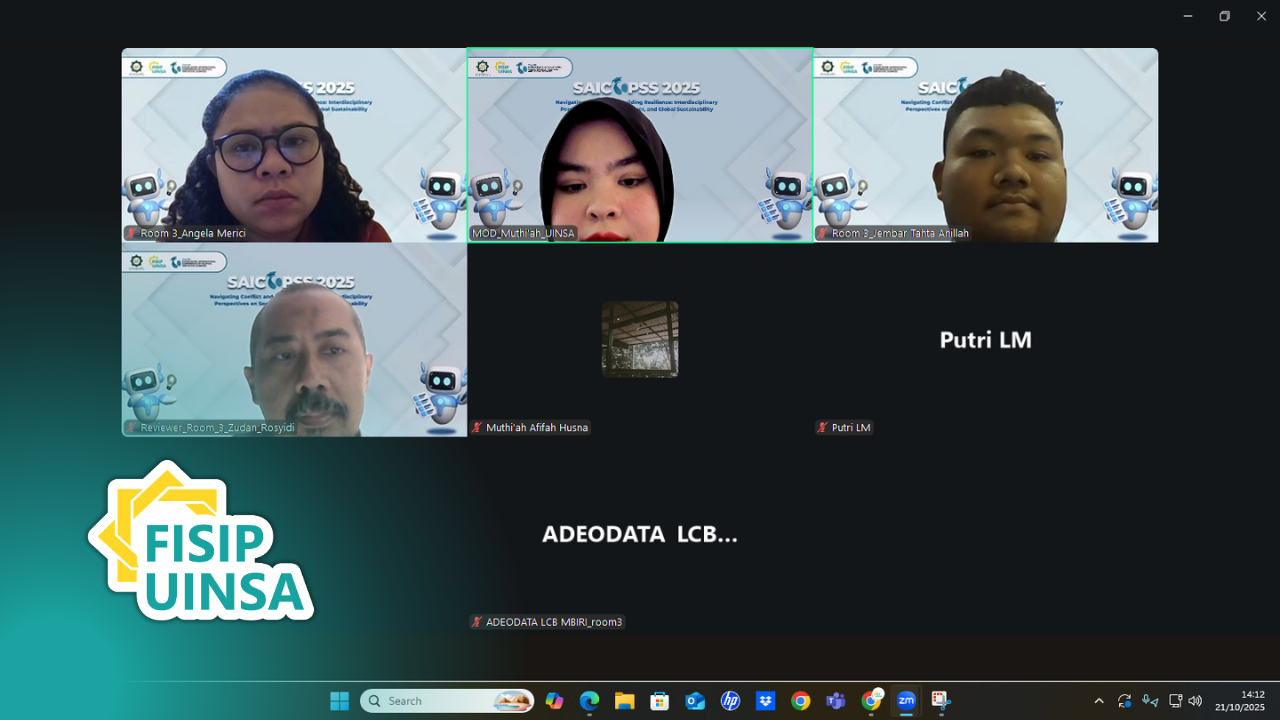
(Surabaya, 21 Oktober 2025)The Sunan Ampel International Conference on Political and Social Science (SAICoPSS) 2025 commenced its parallel sessions by immediately challenging conventional approaches to global governance. Day 1, Room 3, dedicated to the specialized sub-theme, “Cultural Responses to Food and Energy Insecurity,” became a critical forum for scholars arguing that technological fixes and bureaucratic policies often fail without a fundamental understanding of local wisdom, spiritual ethics, and social justice. The session offered a compelling, interdisciplinary triptych: from ancient Balinese manuscripts guiding ecological stewardship to the gendered obstacles to food security in border regions, ultimately connecting these local struggles to the geopolitical crises driven by ideological narratives. The common thread running through the presentations was the affirmation that true resilience is cultural and deeply human.
The Spiritual Anchor: Lontar Wisdom and the Call for Eco-Spiritual Resilience

The discussion began with a fascinating presentation on Eco-Spiritual Resilience, which explored how ingrained local wisdom and spirituality can actively mitigate contemporary sustainability challenges. The research drew illuminating parallels between the environmental ethics found in Balinese Hinduism and the core tenets of Sufism, revealing a shared, profound respect for the natural world rooted in spiritual values.
A central focus was the indigenous knowledge contained within the Lontar Taru Pramana text, a revered manuscript among the Hindu communities of Buleleng, Bali. The Lontar, meaning ‘The Knowledge of Plants,’ serves as more than just a sacred text; it functions as a practical ecological guide. It outlines the philosophy of Tri Hita Karana harmony between humans, the environment, and God by detailing the appropriate relationships between humans, various plant species, and the broader natural ecosystem. This wisdom intrinsically links ecological health to spiritual well-being, effectively mandating conservation as a religious duty. This deep-seated ethical system ensures resource moderation, directly contributing to local food and energy security through sustainable practices. Paralleling this, the study highlighted Sufi practices that promote environmental protection through the concept of amanah (divine trust), urging practitioners towards moderation and responsible stewardship of the earth as a sacred, temporary deposit from the Creator.

However, the scholars collectively sounded an alarm: despite the profound relevance of these traditions, the younger generations’ understanding and adherence to such ecological wisdom are rapidly fading. The forces of urbanization, secular education, and mass consumerism are severing the crucial intergenerational transmission chain. The presenters urged institutions, including UINSA, to actively engage in revitalizing this eco-spiritual heritage as a potent means to reconnect culture, ethics, and environmental protection. This cultural intervention is seen as vital for building a genuine, community-driven resilience that is far more robust and enduring than reliance on externally imposed regulations.
The Social Anchor: Gender Inequality as the Root of Food Insecurity in Borderlands
The session then shifted analytical focus to the painful nexus of food insecurity and gender inequality in Indonesia’s most vulnerable regions. Presenters shared alarming findings from East Nusa Tenggara (NTT), a region along the border with Timor Leste (RDTL), demonstrating why this province remains one of Indonesia’s most food-insecure territories. The analysis revealed that food scarcity is fundamentally a symptom of deep-seated social injustice.
The research critically addressed the impact of patriarchal traditions in Timor Tengah Utara (TTU), documenting how customs have historically and currently marginalized women, despite their central role in food production. Specifically, the practice of belis (dowry), once a symbol of respect and honour for the woman, has regrettably devolved into a significant economic burden on families, diverting essential capital away from productive agricultural investment and household needs. More systemically damaging were the inheritance customs that favor men, effectively denying women the primary agricultural laborers control and ownership over productive assets, particularly land. This lack of resource ownership severely restricts their economic agency and ability to innovate, directly compromising the food sovereignty of the entire community.

The stark conclusion presented was that achieving true and lasting food security must proceed in lockstep with the comprehensive empowerment of women and the structural strengthening of local social structures. Researchers called for immediate policy interventions aimed at promoting gender equality in land tenure, access to credit, and community leadership. The study emphasized that inclusive and sustainable development in the border area requires recognizing and rectifying the systemic marginalization and violence endured by women, thereby unleashing their potential as the most effective drivers of local food security.
The Ideological Anchor: Constructivism and Geopolitical Resilience
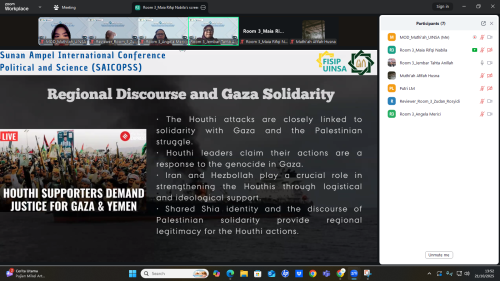
The session broadened its scope to include a highly relevant geopolitical discussion: A constructivist analysis of the Houthi attacks on US Merchant Ships in the Red Sea. While seemingly a departure from “food and energy insecurity,” this presentation aligned perfectly with SAICoPS’s overarching theme of understanding how belief systems and identities drive social and geopolitical resilience.
The researchers utilized the constructivist theory to argue that the Houthi movement’s actions are not merely military or strategic but are powerfully framed as expressions of deep ideological solidarity with Gaza and a potent form of resistance against perceived Western hegemony. The analysis revealed that the Houthis, supported by allies like Iran and Hezbollah, strategically exploit a shared Shia identity and powerful anti-oppression narratives to gain domestic and regional legitimacy. This framing transforms a military operation into a cultural and religious statement, solidifying their power base by appealing to a collective identity. The presentation underscored the critical insight that religious and cultural narratives play a foundational role in shaping global political solidarity, proving that ideological conviction can be a powerful engine for geopolitical action and a defining feature of a group’s political resilience.
In synthesis, the parallel session in Room 3 successfully demonstrated that genuine responses to crises—whether environmental, nutritional, or political are inherently multi-layered. By highlighting the cultural wisdom of the Lontar, the social imperative of gender equity in NTT, and the ideological power in the Red Sea, SAICoPS 2025 provided an invaluable platform for advancing political and social science research toward more holistic and culturally informed solutions. (MAH)
Untuk informasi lebih lanjut mengenai kegiatan dan program FISIP UINSA, silakan kunjungi dan ikuti media sosial kami di Instagram.